Crypto Guide: Exchanges, Wallets, Fees & Security
The Complete Crypto Guide: Top Exchanges, Wallets, Fees, and Security Strategies
Navigating the cryptocurrency ecosystem can be challenging, especially when choosing an exchange, selecting the right wallet, understanding trading and withdrawal fees, and protecting your digital assets.
This comprehensive guide explains the major types of cryptocurrency exchanges and wallets, compares leading platforms, breaks down common fee structures, and provides practical security strategies for both beginners and experienced crypto users.
Important: Cryptocurrency fees, supported networks, regulations, product availability, and user statistics can change frequently and may vary by country, account type, payment method, and network conditions. Always verify current information directly with the relevant provider before transferring funds.
Part 1: Cryptocurrency Exchanges and Wallets
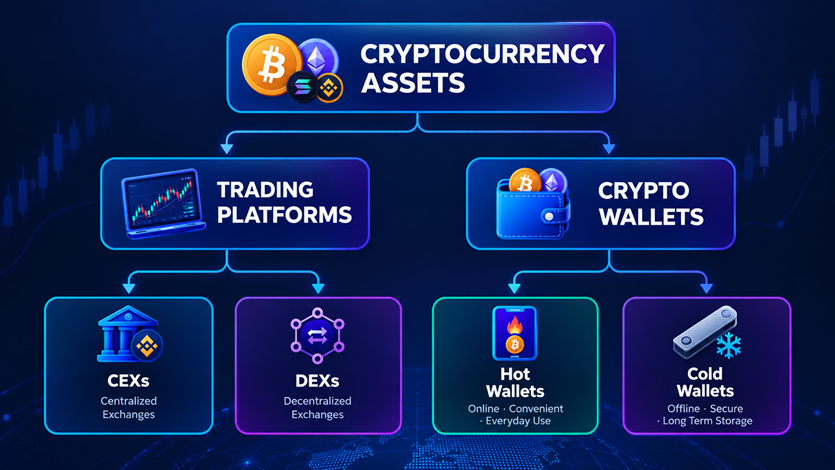
The crypto ecosystem is built around two primary components:
- Exchanges – platforms used to buy, sell, swap, and trade digital assets.
- Wallets – tools used to control and manage the cryptographic keys that provide access to blockchain assets.
A simplified view of the ecosystem looks like this:
1. Centralized Exchanges (CEXs)
Centralized exchanges are managed trading platforms that allow users to buy, sell, and exchange cryptocurrencies. Many support fiat currencies such as USD, EUR, and GBP in addition to crypto-to-crypto trading.
CEXs typically provide:
- High liquidity
- Advanced trading interfaces
- Limit, market, and stop orders
- Derivatives and margin products on eligible platforms
- Fiat deposits and withdrawals
- Account recovery and customer support
The trade-off is that users generally rely on the exchange to custody assets unless they withdraw them to a self-custody wallet. Identity verification, commonly known as KYC (Know Your Customer), is also required in many jurisdictions.
Major Centralized Exchanges
Binance – A major global cryptocurrency exchange offering spot trading, derivatives, staking-related products, and a broad digital-asset ecosystem.
Coinbase – A US-based, publicly traded cryptocurrency company known for its user-friendly interface, institutional services, and emphasis on regulatory compliance.
Kraken – A long-established exchange offering spot and derivatives trading, fiat support, and security-focused custody and account features.
OKX – A global crypto platform combining spot and derivatives trading with integrated Web3 and decentralized-finance tools.
Bybit – Particularly well known for derivatives, perpetual contracts, leverage products, and automated trading features.
KuCoin – A global exchange known for supporting a wide range of digital assets, including many smaller-cap tokens.
Gate.io – A large multi-asset platform offering access to numerous cryptocurrency markets and emerging tokens.
Bitfinex – A professional-oriented exchange offering advanced trading tools, margin products, and liquidity-focused services.
Gemini – A US-based cryptocurrency platform that emphasizes compliance, custody, and security infrastructure.
Crypto.com – A consumer-focused crypto ecosystem offering trading, payments, card-related products, and other digital-asset services.
2. Decentralized Exchanges (DEXs)
Decentralized exchanges operate through blockchain-based smart contracts rather than relying on a traditional centralized intermediary.
Users generally connect a self-custody wallet and interact directly with the protocol.
Advantages can include:
- Self-custody
- Permissionless access in supported jurisdictions
- Direct on-chain settlement
- Access to a broad range of tokens
- Integration with decentralized applications
However, DEXs also introduce additional risks, including smart-contract vulnerabilities, phishing attacks, malicious token approvals, price impact, and impermanent loss for liquidity providers.
Major Decentralized Exchanges and Protocols
Uniswap – One of the most prominent automated market maker (AMM) protocols in the Ethereum ecosystem, with deployments across multiple networks.
PancakeSwap – A major decentralized exchange initially associated with BNB Chain and subsequently expanded to additional networks.
Raydium – A major Solana-based decentralized trading and liquidity protocol designed for fast, low-cost transactions.
Curve Finance – A decentralized exchange optimized primarily for stablecoins and similarly priced assets, with an emphasis on efficient swaps and low slippage.
Balancer – A programmable liquidity protocol that allows users to create and manage customized liquidity pools.
dYdX – A decentralized trading platform focused primarily on perpetual contracts and leveraged trading.
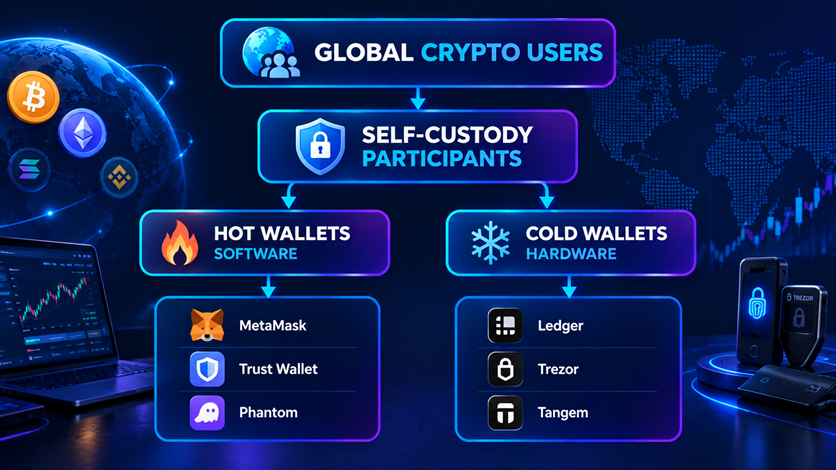
3. Self-Custody Crypto Wallets
Self-custody wallets allow users to control their own private keys rather than relying on an exchange or other third party.
This provides greater control over assets, but it also transfers responsibility for security and recovery to the user.
Software Wallets – Hot Storage
Hot wallets are software wallets that remain connected to internet-enabled devices.
MetaMask
A widely used wallet for Ethereum and other EVM-compatible blockchain networks. It is commonly used to interact with Web3 applications and decentralized finance.
Trust Wallet
A multi-chain mobile wallet supporting a broad range of blockchain networks and digital assets.
Phantom
A popular wallet originally designed around Solana and now supporting additional networks and Web3 functionality.
Coinbase Wallet
A separate self-custody wallet that allows users to manage their own keys independently of the custodial Coinbase exchange account.
Exodus
A consumer-friendly wallet available across supported desktop and mobile environments, with integrated asset-management and swapping features.
Atomic Wallet
A multi-asset software wallet offering portfolio management and integrated exchange functionality.
4. Hardware Wallets – Cold Storage
Hardware wallets are physical devices designed to keep private keys isolated from internet-connected computers and phones.
Popular examples include:
Ledger
Ledger offers several hardware-wallet models designed to isolate cryptographic keys and authorize transactions through dedicated hardware.
Trezor
Trezor produces hardware wallets emphasizing open-source software and on-device transaction verification.
Tangem
Tangem uses a card-style hardware-wallet design with NFC-based interaction and transaction authorization.
Hardware wallets are generally best suited to users holding significant amounts of cryptocurrency for longer periods.
Part 2: Binance vs. Coinbase vs. Kraken
Choosing a centralized exchange involves more than simply finding the lowest advertised trading fee.
Users should consider:
- Trading fees
- Deposit and withdrawal costs
- Liquidity
- Security history
- Regulatory environment
- Supported assets
- Available countries
- Fiat payment options
- Customer support
- Proof-of-reserves or other transparency measures
- Account-security features
Exchange Comparison
| Feature | Binance | Coinbase | Kraken |
|---|---|---|---|
| Primary Strength | Competitive fees and deep liquidity | User experience and regulatory focus | Security and advanced trading |
| Typical Base Spot Fees* | Often around 0.10% | Higher on simple purchases; Advanced Trade generally lower | Competitive Pro-tier fees |
| Instant Buy | Spread and/or transaction fee may apply | Spread and transaction fee may apply | Spread/payment fees may apply |
| Volume Discounts | Yes | Yes | Yes |
| Proof of Reserves | Available for supported assets | Transparency and financial reporting vary by product | Proof-of-reserves reporting available |
| Fiat Support | Varies by jurisdiction | Strong US fiat integration | Strong fiat funding options |
| Regulatory Environment | Varies significantly by jurisdiction | US-focused public-company structure | Operates through multiple regulated entities |
| Best For | Active traders seeking competitive pricing | Beginners and users prioritizing ease of use | Advanced users focused on security and trading tools |
*Fees and features change frequently and can differ by jurisdiction, trading volume, payment method, and account level. Check each exchange’s current fee schedule before trading.
Binance
Binance is particularly attractive to active traders because of its broad product range, deep liquidity, and generally competitive trading fees.
Users may also receive additional benefits through eligible fee-discount programs.
Best suited for: Active traders, users seeking a broad selection of markets, and experienced crypto users.
Coinbase
Coinbase is often attractive to beginners because of its straightforward interface, established US presence, fiat integration, and publicly traded corporate structure.
The trade-off is that convenience-oriented purchases can be significantly more expensive than using an advanced trading interface.
Best suited for: Beginners, US users, and investors who prioritize convenience and a familiar regulated-company environment.
Kraken
Kraken offers a strong combination of advanced trading functionality, security features, and fiat support.
Using its professional trading interface can provide significantly better pricing than simple instant-buy transactions.
Best suited for: Experienced users who want advanced trading functionality and a security-focused platform.
Part 3: Deposits, Withdrawals, and Fee Structures
Crypto transaction costs come from several different sources, and it is important not to confuse them.
A user’s total cost may include:
- Exchange trading fees
- Payment-processing fees
- Fiat deposit fees
- Fiat withdrawal fees
- Blockchain network fees
- Spread or price-impact costs
Fiat Deposit Methods
The availability and cost of fiat funding depend heavily on the user’s country and payment provider.
Binance
Depending on the jurisdiction, Binance may support methods such as:
- Bank transfers
- Local payment networks
- SEPA transfers
- FPS transfers
- Debit or credit cards
Bank-transfer costs can be relatively low, while card purchases generally carry higher processing costs.
Coinbase
Coinbase supports several fiat funding methods in supported markets.
For US customers, ACH transfers may offer a relatively inexpensive way to fund an account, while card-based purchases can carry substantially higher costs.
Wire-transfer fees may also apply depending on the transfer type.
Kraken
Kraken supports various fiat funding methods, including eligible bank-transfer systems such as ACH, SEPA, and FedWire.
Costs and processing times depend on the selected currency, banking partner, and funding method.
Understanding Withdrawal Costs
Withdrawal costs generally fall into two categories:
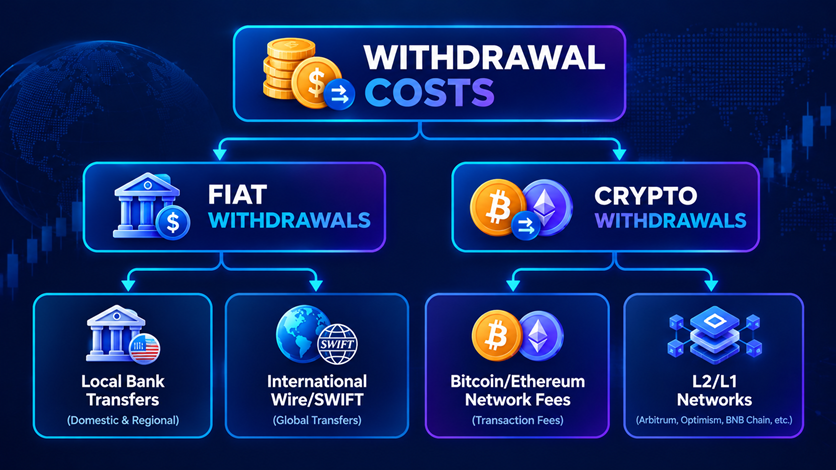
1. Fiat Withdrawals
ACH and Local Bank Transfers
Local bank transfers are often among the cheapest methods for withdrawing fiat, depending on the country and exchange.
International Wire Transfers
International wires and SWIFT transfers can involve fixed administrative fees and intermediary-bank charges.
Depending on the provider and route, total costs can range from relatively modest fees to substantially higher amounts.
Always check the final fee before confirming the withdrawal.
2. Cryptocurrency Withdrawals
Crypto withdrawals work differently from fiat withdrawals.
Instead of charging a percentage of the amount being withdrawn, exchanges generally charge either:
- A fixed withdrawal fee
- A dynamically calculated fee
- A fee designed to cover or partially cover the underlying network cost
The final cost depends on both the exchange and the blockchain being used.
Bitcoin
Bitcoin withdrawal costs vary by exchange and network conditions. Some exchanges use fixed withdrawal fees, while others dynamically adjust fees.
Ethereum
Ethereum transaction costs can fluctuate significantly because network fees depend on congestion and gas-market conditions.
Layer-1 and Layer-2 Networks
Networks such as Solana, Polygon, and Arbitrum can offer substantially lower transaction costs than congested Bitcoin or Ethereum transactions.
However, users must ensure that the receiving wallet supports the exact network and token standard being used.
Important: A low network fee does not automatically make a transfer safer. Sending funds over an unsupported network can result in lost or difficult-to-recover assets.
Part 4: Crypto Wallet and Adoption Statistics
Measuring the number of cryptocurrency wallets is difficult because blockchain networks allow users to generate virtually unlimited addresses.
One person can control:
- One wallet
- Multiple wallets
- Hundreds of addresses
- Multiple accounts across different blockchains
Therefore, wallet addresses should not be treated as equivalent to individual users.
A more useful framework considers exchange users, active self-custody users, wallet downloads, and hardware devices sold.
Reported adoption figures for major wallets can include registered accounts, downloads, monthly active users, or devices sold. These metrics are not directly comparable.
For example:
- Trust Wallet – Widely used as a mobile multi-chain wallet.
- MetaMask – One of the most established interfaces for EVM-based Web3 applications.
- Phantom – A leading wallet within the Solana ecosystem and increasingly multi-chain.
- Ledger – One of the most widely recognized hardware-wallet brands.
- Trezor – A long-standing hardware-wallet manufacturer with a strong open-source focus.
Data note: User counts and device-sales figures change over time and may use different definitions. Always verify the latest figures from the wallet provider before publishing statistics.
Part 5: Hot Wallets vs. Cold Wallets
The most important distinction between hot and cold wallets is how private keys are protected from internet-connected environments.
1. Key Generation
Hot Wallet
A software wallet generates and stores cryptographic key material within or through an internet-connected computing environment such as a phone, browser, or computer.
This creates potential exposure to:
- Malware
- Keyloggers
- Malicious browser extensions
- Phishing
- Device compromise
Hardware Wallet
A hardware wallet is designed to generate and protect private keys within dedicated hardware.
The goal is to ensure that the private key itself does not need to leave the secure device when a transaction is signed.
2. Transaction Construction
When you initiate a transaction, the connected application prepares the transaction data.
This may include:
- Destination address
- Amount
- Network
- Gas or transaction fee
- Contract interaction data
The transaction can then be sent to the hardware wallet for verification and signing.
3. Cryptographic Signing
Signing is the process that authorizes a blockchain transaction.
Hot Wallet
The software wallet signs the transaction using key material accessible to the device running the wallet.
Hardware Wallet
The unsigned transaction is transferred to the hardware device.
The user should verify important transaction details on the hardware device’s screen before approving the transaction.
The device then signs the transaction internally.
The private key itself should remain inside the hardware wallet.
4. Broadcasting to the Blockchain
After signing:
- The signed transaction is returned to the connected application.
- The application broadcasts it to the blockchain network.
- Network validators or miners process the transaction.
- Once confirmed, the blockchain records the resulting state change.
The private key does not need to be transmitted to the blockchain or the internet.
Hot Wallet vs. Hardware Wallet
| Security Attribute | Hot Wallet | Hardware Wallet |
|---|---|---|
| Internet Exposure | Connected to internet-enabled device | Key remains isolated within dedicated hardware |
| Key Storage | Software/device environment | Dedicated hardware |
| Transaction Approval | Phone/computer interface | Hardware-device confirmation |
| Cost | Usually free | Typically paid |
| Convenience | Excellent | Moderate |
| Main Risks | Malware, phishing, compromised device | Phishing, malicious transactions, physical loss |
| Best Use | Small balances and frequent Web3 activity | Long-term or higher-value holdings |
A hardware wallet significantly reduces certain online attack risks, but it does not make a user immune to scams or malicious transactions.
Critical Crypto Security Practices
1. Beware of Malicious Smart Contracts
A hardware wallet can protect private keys from being remotely extracted, but it cannot protect you from voluntarily authorizing a malicious transaction.
For example, a user may connect a hardware wallet to a fraudulent website and approve:
- A malicious token approval
- A deceptive NFT transaction
- A harmful smart-contract interaction
- An unauthorized spending allowance
The hardware device can confirm that you authorized a transaction, but it cannot always determine whether the transaction is economically safe.
Always understand what you are signing.
2. Never Digitize Your Recovery Phrase
Your 12- or 24-word recovery phrase is one of the most sensitive pieces of information associated with a self-custody wallet.
Never:
- Photograph it
- Screenshot it
- Email it
- Store it in cloud storage
- Type it into a website
- Enter it into a computer or phone unless you fully understand the security implications and are intentionally performing a legitimate recovery
- Share it with customer support
Anyone who obtains the recovery phrase may be able to gain control of the associated wallet.
3. Use a Two-Wallet Architecture
A practical strategy is to separate long-term holdings from everyday Web3 activity.
Long-Term Wallet
Use a hardware wallet for assets intended for long-term storage.
Everyday Wallet
Use a separate hot wallet for:
- Decentralized applications
- Token swaps
- NFTs
- Experimental protocols
- Small transactions
Only keep the amount you are willing to expose to additional smart-contract and phishing risk in the hot wallet.
Part 6: Hardware Wallet Setup Guide
Setting up a hardware wallet correctly is more important than simply purchasing one.
Step 1: Inspect and Authenticate the Device
Purchase the device from the manufacturer’s official store or an authorized reseller whenever possible.
Before using it:
- Inspect the packaging and device for signs of tampering.
- Follow the manufacturer’s authenticity-verification process.
- Make sure the device asks you to initialize it.
- Never use a device that arrives with an existing PIN.
- Never use a device that arrives with a pre-written recovery phrase.
A legitimate new hardware wallet should generate its recovery phrase during setup.
Step 2: Download the Official Companion Software
Download the manufacturer’s official application from its official website.
Examples include the manufacturer’s desktop or mobile wallet-management software.
Avoid:
- Sponsored search advertisements
- Unknown download websites
- Unofficial app stores
- Links sent through unsolicited messages
- Fake customer-support accounts
Phishing applications can look remarkably similar to legitimate wallet software.
Step 3: Create a Strong Device PIN
Connect the hardware wallet and select the option to initialize it as a new device.
Then:
- Create a unique PIN.
- Enter it directly on the hardware device when required.
- Avoid predictable combinations such as
1234, repeated digits, or easily guessed dates. - Never share your PIN.
The exact PIN requirements depend on the hardware-wallet manufacturer.
Step 4: Generate and Secure Your Recovery Phrase
This is the most important step.
During initialization, the hardware wallet should generate a recovery phrase, commonly consisting of 12 or 24 words depending on the device and setup.
Record the words:
- In the exact order shown
- Carefully and legibly
- On paper or a suitable durable backup
- In a private, secure location
For higher-value holdings, consider a durable metal backup designed for recovery phrases.
Never store the recovery phrase:
- In a phone
- In a computer
- In an email account
- In cloud storage
- In a password manager unless you have deliberately evaluated the security trade-offs
- As a photograph
The recovery phrase should remain offline.
Step 5: Verify the Recovery Backup
The device will normally require you to confirm selected words or the entire recovery phrase.
Complete this process carefully.
A single incorrect word or incorrect order can prevent successful recovery later.
Step 6: Update the Firmware
Use the manufacturer’s official software to determine whether a firmware update is available.
Only install firmware through the manufacturer’s legitimate update mechanism.
Do not install firmware provided through:
- Telegram
- Discord
- Social media
- Random websites
- Unverified support accounts
Step 7: Perform a Small Test Transaction
Before transferring a substantial amount:
- Create the appropriate asset account.
- Select Receive.
- Compare the destination address shown by your software with the address displayed on the hardware device.
- Send a small test amount.
- Wait for blockchain confirmation.
- Verify that the funds arrived correctly.
- If appropriate, perform a small test withdrawal to confirm the complete transaction process.
Only after successful testing should you consider transferring larger amounts.
Part 7: Essential Security Rules
The Recovery Phrase Rule
No legitimate exchange representative, wallet-support agent, or software application should require you to disclose your recovery phrase.
Treat any request to provide your recovery words as a potential theft attempt.
If a website tells you to enter your seed phrase to:
- Verify your wallet
- Synchronize your wallet
- Unlock your funds
- Claim an airdrop
- Resolve a security issue
- Recover an account
Stop immediately.
Physical Backup Protection
Your recovery backup should be protected from:
- Fire
- Water
- Theft
- Unauthorized access
- Accidental destruction
For significant holdings, consider storing the recovery backup separately from the hardware wallet itself.
The goal is to avoid a single event destroying both the wallet and its recovery information.
Optional Advanced Protection: Passphrase
Some hardware wallets support an additional passphrase, sometimes informally called a “25th word.”
A passphrase creates an additional wallet derived from the recovery phrase plus the chosen passphrase.
This can provide an additional layer of protection, but it also introduces another critical responsibility:
If you forget the passphrase, the wallet cannot generally be recovered simply by knowing the original recovery phrase.
A passphrase should therefore only be used if you understand the recovery process and have a secure plan for remembering or recovering it.
Frequently Asked Questions
Q1. What Is the Difference Between a Crypto Exchange and a Crypto Wallet?
Crypto Exchange
An exchange is a platform where users can buy, sell, swap, or trade cryptocurrency.
When assets remain on a centralized exchange, the exchange generally controls the private keys associated with those assets.
This is known as custodial storage.
Crypto Wallet
A self-custody wallet allows the user to control the private keys associated with their assets.
Wallets can be software-based or hardware-based.
The fundamental difference is who controls the keys.
Q2. What Does “Not Your Keys, Not Your Coins” Mean?
“Not your keys, not your coins” is a common crypto expression describing the principle of self-custody.
If a centralized exchange controls the private keys, the user depends on that platform to provide access to the assets.
Potential risks include:
- Exchange insolvency
- Account restrictions
- Frozen withdrawals
- Security breaches
- Operational failures
Self-custody removes the exchange from the custody equation, but it also makes the user responsible for protecting the private keys and recovery phrase.
Q3. Is a Hardware Wallet 100% Hack-Proof?
No.
Hardware wallets are designed to protect private keys from many types of online attacks, but they cannot eliminate every risk.
You can still lose funds through:
- Phishing
- Fake wallet software
- Malicious smart contracts
- Fraudulent token approvals
- Fake airdrops
- Address replacement malware
- Recovery-phrase theft
- Physical theft combined with compromised credentials
The hardware wallet protects the key, but the user remains responsible for deciding what transactions to authorize.
Q4. What Happens If I Lose My Hardware Wallet?
Your cryptocurrency is not physically stored inside the hardware wallet.
The blockchain records ownership and transaction history.
The hardware wallet protects the cryptographic keys used to authorize transactions.
If the hardware device is lost or destroyed, you can generally restore access using the correct recovery phrase on a compatible wallet or replacement hardware device.
However, anyone who obtains your recovery phrase may also be able to restore the wallet.
Therefore, protecting the recovery phrase is more important than protecting the physical device alone.
Q5. Why Do Cryptocurrency Withdrawal Fees Differ Between Coins?
Different blockchain networks have different transaction architectures, congestion levels, and fee mechanisms.
For example:
- Bitcoin uses its own transaction-fee market.
- Ethereum uses gas-based transaction pricing.
- Solana generally has low transaction costs.
- Layer-2 networks can reduce transaction costs by processing activity more efficiently than the underlying Layer-1 network.
Exchanges may also add their own withdrawal fees on top of or instead of directly passing through network costs.
Therefore, the amount displayed by an exchange should always be checked before confirming a withdrawal.
Q6. What Happens If I Send Crypto Using the Wrong Network?
Blockchain transactions are generally irreversible once confirmed.
Sending an asset using an incompatible network can result in:
- Permanent loss of funds
- Funds becoming inaccessible
- A complicated recovery process
- Additional fees or technical intervention being required
For example, an exchange may support the same token across multiple networks. Choosing the wrong network can cause the receiving platform or wallet to be unable to recognize the deposit.
Before sending funds, always verify:
- The destination address
- The cryptocurrency
- The blockchain network
- The token standard, where applicable
- The exchange’s deposit instructions
For significant transfers, send a small test transaction first.
Final Crypto Security Checklist
Before transferring or storing significant cryptocurrency, use this checklist:
- Buy hardware wallets from legitimate sources.
- Initialize the device yourself.
- Never use a pre-generated recovery phrase.
- Create a unique device PIN.
- Write down the recovery phrase offline.
- Never photograph or upload the recovery phrase.
- Keep the recovery backup physically secure.
- Consider durable backup storage for substantial holdings.
- Download wallet software only from official sources.
- Keep wallet firmware and software updated.
- Verify addresses on the hardware device before signing.
- Understand smart-contract approvals before authorizing them.
- Keep long-term holdings separate from everyday Web3 activity.
- Maintain only limited funds in a hot wallet.
- Test small transactions before transferring large amounts.
- Verify the destination network before every transfer.
- Never give your recovery phrase to anyone.
- Treat unsolicited “support” messages as potential scams.
Final Takeaway
There is no single exchange or wallet that is perfect for every crypto user.
The right choice depends on your objectives:
- For active trading: prioritize liquidity, trading fees, and advanced order functionality.
- For beginners: prioritize ease of use, fiat access, security controls, and regulatory transparency.
- For decentralized applications: use a reputable self-custody wallet and keep only limited funds exposed to smart-contract risk.
- For long-term holdings: consider a reputable hardware wallet and maintain a carefully protected offline recovery backup.
The most important principle is simple:
Crypto security is not just about choosing the right platform—it is about controlling your keys, verifying every transaction, protecting your recovery phrase, and understanding what you are signing.
A secure setup combines the right exchange, the right wallet, disciplined transaction practices, and a well-designed recovery strategy.
Read More
- best crypto exchanges
- best crypto wallets
- crypto exchange fees
- crypto wallet security
- hot wallet vs cold wallet
- hardware crypto wallet
- crypto withdrawal fees
- cryptocurrency security
- crypto exchange comparison
- self-custody crypto wallet