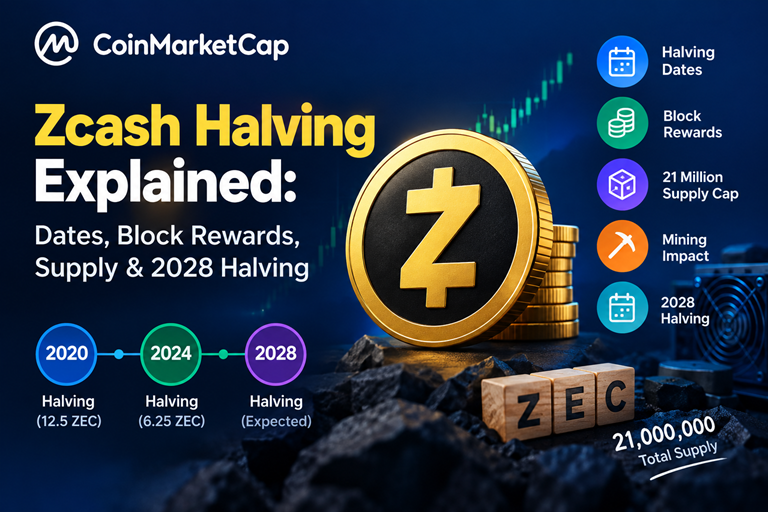
Zcash Halving Explained: Dates, Block Rewards, Supply & 2028 Halving
Zcash Halving: Complete Guide to ZEC Halvings, Mining Rewards, Supply and What Comes Next
Zcash halving, also known as the Zcash “halvening,” is one of the most important events in the monetary policy of the Zcash blockchain. It reduces the amount of newly created ZEC paid through the block subsidy, lowering the rate at which new coins enter circulation.
Like Bitcoin, Zcash has a maximum supply of 21 million ZEC. However, Zcash has its own issuance schedule, mining economics, development-funding history and network-upgrade process. Understanding these differences is important for investors, miners and anyone following the long-term economics of ZEC.
The first Zcash halving occurred in November 2020, when the original Founders’ Reward expired and the block reward fell to 3.125 ZEC. The second halving took place in November 2024, reducing the block subsidy again, from 3.125 ZEC to 1.5625 ZEC per block.
The next major halving is expected around November 2028, although the exact timing is determined by block height rather than a fixed calendar date.
This guide explains everything you need to know about Zcash halving, including how it works, its history, mining rewards, supply implications, the development fund, miner profitability, market effects and what the next halving could mean for ZEC.
What Is Zcash?
Zcash is a cryptocurrency and blockchain network designed to provide users with the option of conducting transactions with enhanced privacy.
The network was launched on October 28, 2016, and uses zero-knowledge cryptography, including zk-SNARK technology, to enable shielded transactions. Zcash supports both transparent and shielded transaction mechanisms.
The native cryptocurrency of the network is ZEC.
Some of the defining characteristics of Zcash include:
- A maximum supply of 21 million ZEC.
- Proof-of-work mining.
- A programmed issuance schedule.
- Periodic reductions in block subsidies.
- Optional privacy through shielded transactions.
- Transparent and shielded address systems.
- A smallest unit called a zatoshi, equal to 0.00000001 ZEC.
Zcash’s monetary policy is therefore closely connected to mining. Miners secure the network by producing blocks, and the protocol rewards them with newly created ZEC plus transaction fees.
The halving mechanism gradually reduces the amount of newly created ZEC distributed through this process.
What Is the Zcash Halving?
The Zcash halving is a programmed reduction in the block subsidy paid to miners.
In simple terms:
When a halving occurs, the number of new ZEC created through each block is reduced by 50%.
This does not mean that existing ZEC balances are cut in half.
For example, if a miner previously received a 3.125 ZEC block subsidy, a halving reduces that subsidy to 1.5625 ZEC. The ZEC already held by users remains unchanged.
The purpose of this mechanism is to progressively reduce monetary issuance and help Zcash approach its 21 million ZEC maximum supply.
According to Zcash documentation, after the initial issuance period, each subsequent 840,000 blocks triggers another block reward halving.
Zcash Halving vs. Bitcoin Halving
Zcash and Bitcoin both use a halving mechanism, but the two networks are not identical.
Bitcoin‘s block subsidy halves approximately every 210,000 blocks, while Zcash’s issuance schedule uses longer halving intervals of approximately 840,000 blocks after the first halving.
Both systems are designed around a finite maximum supply and declining issuance.
The basic economic principle is similar:
Fewer newly created coins + unchanged or increasing demand = potentially greater scarcity.
However, scarcity by itself does not guarantee that the price of a cryptocurrency will rise. Market demand, adoption, liquidity, investor sentiment, mining economics, regulation and broader crypto-market conditions can all influence ZEC’s price.
Zcash Maximum Supply: 21 Million ZEC
One of the most important features of Zcash’s monetary policy is its 21 million ZEC supply cap.
This creates a finite monetary base similar to Bitcoin. Zcash documentation confirms that the maximum supply is 21 million units.
The supply is not released into circulation all at once.
Instead, ZEC is gradually created as miners produce new blocks.
As the block subsidy decreases through successive halvings, the rate of new ZEC issuance also declines.
This creates a declining issuance curve:
Higher issuance → lower issuance → lower issuance → eventual approach toward the 21 million supply limit.
Zcash Block Time and Mining
Zcash uses proof-of-work mining to secure its blockchain.
Blocks are produced approximately every 2.5 minutes on average, according to Zcash’s documentation.
A successful miner receives the applicable block subsidy and transaction fees associated with the block.
The block subsidy is particularly important because it represents newly created ZEC.
Consequently, a halving has a direct effect on mining economics.
If the ZEC price remains unchanged while the block subsidy falls by 50%, miners theoretically receive approximately half as much ZEC from the subsidy per block.
However, real-world mining profitability depends on several variables, including:
- ZEC market price.
- Mining hardware efficiency.
- Electricity costs.
- Network difficulty.
- Hashrate.
- Mining-pool fees.
- Transaction fees.
- Hardware depreciation.
- Operational expenses.
This means the impact of a halving can differ substantially between miners.
History of Zcash Halvings
Zcash has already experienced two major halvings.
The First Zcash Halving – 2020
The first Zcash halving occurred in November 2020 at block height 1,046,400 according to the original issuance schedule.
The event followed the initial four-year issuance period and coincided with the Canopy network upgrade.
Canopy was specifically described by Zcash documentation as coinciding with the first Zcash halving.
Before the first halving, the original Zcash block reward was structured differently from later rewards.
During the initial period, miners received 80% of the block reward, while the remaining 20% was distributed among the Founders’ Reward beneficiaries.
After the first halving, the original Founders’ Reward expired.
The block reward became 3.125 ZEC, with 80% of issuance continuing to miners and 20% initially allocated through a new development-funding structure.
The first halving was therefore more than simply a reduction in mining rewards.
It represented a major transition in Zcash’s economic and governance model.
The Second Zcash Halving – 2024
The second Zcash halving occurred in November 2024 alongside Network Upgrade 6, or NU6.
At this event, the block subsidy was reduced from:
3.125 ZEC → 1.5625 ZEC
That represents a 50% reduction in the amount of newly created ZEC per block.
NU6 activated at block height 2,726,400, around November 23, 2024.
The 2024 halving was particularly significant because it also changed how Zcash development funding was handled.
Rather than continuing the previous direct funding model, NU6 introduced a lockbox-based mechanism and moved the ecosystem toward a more decentralized, non-direct development-funding approach.
The Next Zcash Halving – Around 2028
The next major Zcash halving is expected around November 2028.
The exact date should not be treated as permanently fixed because Zcash halving events are ultimately tied to blockchain block heights, while calendar dates depend on actual block production.
The 2025 Community & Coinholder Funding Model endorsed by Electric Coin Company was described as being active through the third halving, approximately November 2028.
At the next halving, assuming the existing issuance schedule remains unchanged, the block subsidy would be expected to fall from:
1.5625 ZEC → 0.78125 ZEC
This would represent another 50% reduction in the rate of newly created ZEC.
Zcash Halving Schedule
The simplified Zcash reward progression can be represented as follows:
| Period | Approx. Block Reward | Event |
|---|---|---|
| 2016–2020 | 12.5 ZEC | Initial Zcash issuance |
| 2020–2024 | 3.125 ZEC | First halving |
| 2024–~2028 | 1.5625 ZEC | Second halving |
| ~2028–~2032 | 0.78125 ZEC | Expected third halving |
| Later epochs | Continues declining | Subsequent halvings |
The historical issuance details are more complicated than simply looking at headline block rewards because the distribution of the subsidy among miners and development funding has changed over time.
The important point for investors is that the amount of newly created ZEC declines progressively.
Why Does Zcash Halve?
The fundamental purpose of halving is to control the rate at which new ZEC enters the economy.
If a cryptocurrency continuously created large quantities of new coins, the supply could grow rapidly.
A predictable issuance reduction creates monetary scarcity.
Zcash’s design therefore combines:
21 million maximum supply + programmed issuance + periodic halvings.
This makes the long-term supply schedule relatively predictable.
The mechanism also reduces the amount of ZEC that miners need to sell into the market to cover operational costs over time, although miners may still sell ZEC depending on their individual business models.
How Does the Zcash Halving Affect Supply?
The most direct impact of a halving is a reduction in the new supply rate.
Suppose the network produces approximately 576 blocks per day.
At a 1.5625 ZEC block subsidy, ignoring other protocol-specific allocation details:
576 × 1.5625 = 900 ZEC per day
After the next halving:
576 × 0.78125 = 450 ZEC per day
These are simplified calculations based on a 2.5-minute average block interval and the headline block subsidy.
The actual amount allocated to different recipients depends on the protocol’s funding rules.
Nevertheless, the calculation demonstrates the central economic effect:
The amount of newly issued ZEC per day can be cut approximately in half.
Over a year, this difference becomes substantial.
Does the Zcash Halving Automatically Increase ZEC Price?
No.
This is one of the most important points for investors.
A halving does not mathematically guarantee a price increase.
The halving reduces new issuance. Price, however, is determined by market supply and demand.
A simplified economic model is:
Price = f(demand, available supply, liquidity, sentiment, market conditions, adoption and expectations)
If demand increases while new supply declines, the reduced issuance could contribute to upward price pressure.
But if demand declines significantly, ZEC’s price can fall even after a halving.
The market may also anticipate a halving months or years before it happens.
As a result, the price response can occur:
- Before the halving.
- Around the halving.
- Months after the halving.
- Or not in a sustained way at all.
Historical cryptocurrency performance should therefore not be interpreted as proof that every future halving will generate the same outcome.
Impact of Zcash Halving on Miners
Mining is arguably the part of the ecosystem most directly affected by a halving.
A 50% reduction in block subsidy can substantially reduce mining revenue if the ZEC price, transaction fees and other conditions remain unchanged.
For example, consider two simplified scenarios.
Before a hypothetical halving
A miner earns:
1.5625 ZEC per block
After the hypothetical halving
The miner earns:
0.78125 ZEC per block
The miner’s electricity bill, hardware costs and other expenses do not automatically fall by 50%.
This creates a potential profitability squeeze.
Less-efficient miners may be forced to:
- Shut down mining machines.
- Upgrade hardware.
- Move to cheaper electricity.
- Join more efficient mining pools.
- Reduce operating costs.
- Hold some mined ZEC rather than immediately sell it.
If less-efficient miners exit, network hashrate could decline temporarily.
However, the network’s mining difficulty can adjust, helping the remaining miners continue producing blocks according to the protocol’s target.
Zcash Mining Difficulty and Hashrate
A halving should not be viewed in isolation from network hashrate and mining difficulty.
Mining profitability depends on how much computational competition exists.
If many miners leave because the subsidy becomes less profitable, network hashrate can decline.
If ZEC’s price rises substantially, however, mining can remain attractive even with a smaller coin reward.
Therefore:
Halving impact on miners = reward reduction + ZEC price + difficulty + hashrate + electricity + hardware efficiency + fees.
This is why professional miners closely monitor both ZEC’s market price and network statistics.
Zcash Halving and Miner Selling Pressure
One commonly discussed potential effect of a halving is reduced miner selling pressure.
Miners have operating expenses.
Electricity, equipment, hosting, maintenance and other costs may require miners to convert some of their ZEC into fiat or other cryptocurrencies.
If miners receive fewer ZEC per block, the number of newly mined coins potentially entering exchanges can decline.
For example, if the same amount of mining revenue is required to cover operating costs, a higher ZEC price could allow miners to sell fewer coins.
This can create a potential supply-side effect.
However, it is important to distinguish potentially lower new selling pressure from guaranteed price appreciation.
Miner behavior varies significantly across market conditions.
Zcash Halving and Investors
For ZEC investors, the halving is primarily an event concerning monetary supply.
Investors may watch several indicators before and after a halving:
- ZEC price.
- ZEC trading volume.
- Circulating supply.
- Exchange balances.
- Network hashrate.
- Mining difficulty.
- Miner profitability.
- Transaction activity.
- Shielded-pool usage.
- Developer activity.
- Ecosystem adoption.
- Market liquidity.
- Broader Bitcoin and crypto-market trends.
A halving can become an important narrative for market participants because it highlights Zcash’s scarcity and predictable issuance.
But investors should avoid treating the halving as a standalone investment thesis.
The Role of the Zcash Development Fund
One distinctive aspect of Zcash’s history is that block rewards have also been used to fund ecosystem development.
This is different from simply paying miners.
During Zcash’s first four years, the original Founders’ Reward allocated part of newly created ZEC to various beneficiaries. That mechanism expired with the first halving in 2020.
A new development-funding system then allocated part of Zcash issuance to ecosystem development.
The 2020 model allocated:
- 80% to miners.
- 8% to Zcash Community Grants.
- 7% to Bootstrap/ECC.
- 5% to the Zcash Foundation.
This structure lasted until the 2024 halving.
The 2024 NU6 upgrade introduced a different approach.
Under the new system, 12% of block subsidies were routed to a Lockbox, while 8% temporarily continued toward community grants. The purpose was to move Zcash toward a non-direct, more community-driven development-funding structure.
This makes Zcash’s halving events important not only for monetary issuance but also for ecosystem governance.
What Changed in 2024?
The 2024 halving was particularly important for three reasons.
1. The block subsidy was cut in half
The headline subsidy moved from:
3.125 ZEC → 1.5625 ZEC
This reduced the rate at which new ZEC was generated.
2. NU6 activated
The halving coincided with Network Upgrade 6.
NU6 was activated at block height 2,726,400 around November 23, 2024.
3. Development funding became more decentralized
The previous direct-funding structure ended.
ECC and Zcash Foundation addresses were removed from the protocol’s direct funding mechanism, while the ecosystem moved toward a lockbox and grants-based model.
This means the 2024 event was simultaneously a monetary, technical and governance milestone.
What Could Happen During the Next Zcash Halving?
The next halving is expected to reduce the block subsidy from:
1.5625 ZEC → 0.78125 ZEC
Several outcomes are possible.
Scenario 1: ZEC Demand Increases
If demand for ZEC increases while new issuance falls, the reduced supply growth could contribute to stronger market conditions.
This is the classic scarcity thesis.
Scenario 2: ZEC Demand Remains Flat
If demand remains approximately unchanged, the lower issuance rate could gradually reduce the amount of new ZEC entering the market.
The effect on price could still be positive, neutral or difficult to detect depending on liquidity and investor behavior.
Scenario 3: ZEC Demand Falls
A halving cannot protect an asset from declining demand.
If adoption, liquidity or market interest deteriorates significantly, ZEC could decline despite reduced issuance.
Scenario 4: Mining Becomes More Competitive
If ZEC’s price rises substantially before or after the halving, mining could remain profitable despite the lower subsidy.
This could attract or retain miners and potentially support network security.
Is Zcash Halving Bullish?
The answer depends on what “bullish” means.
From a monetary-supply perspective, a halving is generally considered a scarcity-positive event because fewer new coins are produced.
From a price perspective, however, the outcome is uncertain.
A bullish thesis might argue:
- New ZEC issuance decreases.
- Miner selling pressure may decrease.
- The 21 million supply cap remains.
- Scarcity becomes more pronounced.
- Increased demand could have a larger effect on price.
A cautious thesis would point out:
- Halvings are often anticipated in advance.
- Market participants may already price in the event.
- Demand matters more than supply reduction alone.
- Mining profitability can decline.
- Broader cryptocurrency market conditions can dominate ZEC-specific factors.
Therefore, the most accurate statement is:
Zcash halving creates a potentially favorable supply-side condition, but it does not guarantee a price increase.
Zcash Halving and the 21 Million Supply Cap
The long-term significance of Zcash’s halving schedule becomes clearer when viewed against the 21 million ZEC maximum.
Every halving reduces the rate of new issuance.
The sequence is approximately:
12.5 → 3.125 → 1.5625 → 0.78125 → 0.390625 → …
The reward gets progressively smaller.
Eventually, the amount of new ZEC created per block becomes extremely small relative to the total monetary base.
This is the same broad concept behind Bitcoin’s declining issuance curve.
Zcash Halving vs. Inflation
A cryptocurrency’s inflation rate can be thought of as the amount of new supply created relative to the existing supply.
When the number of newly issued ZEC falls, the rate of monetary inflation also declines, assuming other factors remain constant.
For long-term ZEC holders, this is an important feature because their ownership percentage is subject to less dilution from newly created coins as the issuance rate declines.
For example, if the network creates fewer new ZEC each year, existing holders theoretically face less supply dilution than they would under a constant issuance model.
Is Zcash Becoming Scarcer?
Yes, in terms of its new issuance rate.
The total supply does not decrease during a halving.
Instead, the growth of supply slows.
This distinction is crucial.
A halving does not mean:
21 million ZEC → 10.5 million ZEC
Instead, it means:
The rate at which new ZEC is created is reduced by 50%.
Existing ZEC remains in circulation unless it is otherwise lost or inaccessible.
Frequently Asked Questions About Zcash Halving
When was the first Zcash halving?
The first Zcash halving occurred in November 2020 and coincided with the Canopy network upgrade. The block reward fell to 3.125 ZEC.
When was the second Zcash halving?
The second Zcash halving occurred in November 2024 alongside NU6. The block subsidy declined from 3.125 ZEC to 1.5625 ZEC.
When is the next Zcash halving?
The third halving is expected around November 2028, based on the current schedule and the 840,000-block halving cadence. The exact date depends on actual block production.
What will the next Zcash block reward be?
Assuming the current issuance schedule remains unchanged, the headline block subsidy is expected to fall from 1.5625 ZEC to 0.78125 ZEC at the next halving.
Does Zcash halving reduce my ZEC balance?
No.
A halving reduces the amount of new ZEC created through the block subsidy. It does not automatically reduce the ZEC already held in a wallet.
Does Zcash halving guarantee a price increase?
No.
The halving reduces new issuance, but ZEC's market price depends on supply, demand, liquidity, adoption, investor sentiment and broader market conditions.
Does the halving affect Zcash miners?
Yes.
Miners receive fewer newly created ZEC per block after a halving, which can significantly affect mining profitability.
Does Zcash have a maximum supply?
Yes.
Zcash has a maximum supply of 21 million ZEC.
How often does Zcash halve?
After the first halving, Zcash's block reward schedule calls for another halving every 840,000 blocks.
Key Takeaways
The Zcash halving is an important part of the cryptocurrency's long-term monetary policy.
The most important facts are:
- Zcash has a maximum supply of 21 million ZEC.
- The network uses proof-of-work mining.
- Blocks are produced approximately every 2.5 minutes on average.
- The first halving occurred in November 2020.
- The first halving reduced the block reward to 3.125 ZEC.
- The second halving occurred in November 2024.
- The second halving reduced the block subsidy from 3.125 ZEC to 1.5625 ZEC.
- The next halving is expected around November 2028.
- The next scheduled reduction would take the subsidy to approximately 0.78125 ZEC.
- Halvings reduce the rate of new ZEC issuance.
- Lower issuance can increase scarcity but does not guarantee higher prices.
- Mining profitability can come under pressure after a halving.
- Zcash's development-funding system has evolved alongside its halving events.
- The 2024 halving coincided with NU6 and a major transition toward community-driven development funding.
Final Thoughts
The Zcash halving is more than a simple reduction in mining rewards. It is a recurring event that affects ZEC issuance, monetary scarcity, mining economics and, historically, the governance and funding structure of the Zcash ecosystem.
The 2020 halving marked the end of the original Founders' Reward and the beginning of a new development-funding era. The 2024 halving reduced the subsidy to 1.5625 ZEC and coincided with NU6, which introduced a new approach to ecosystem funding and governance.
Looking ahead, the expected third halving around 2028 should reduce the headline block subsidy to approximately 0.78125 ZEC if the current issuance rules remain in place.
For investors, the key lesson is that scarcity is only one side of the equation. A declining supply-growth rate can become economically significant when combined with sustained or growing demand, but it cannot independently determine ZEC's future price.
For miners, the halving represents a direct challenge to revenue and profitability.
For the broader Zcash ecosystem, it is another step toward the project's long-term monetary policy of progressively declining issuance and a fixed maximum supply.
As the cryptocurrency market continues to mature, future Zcash halvings will likely remain closely watched events—not only because of their effect on ZEC's supply, but also because they provide a recurring test of the network's mining economics, governance model, adoption and long-term demand for privacy-focused digital money.
Disclaimer: This article is for informational and educational purposes only and does not constitute financial, investment, trading, tax or legal advice. Cryptocurrency markets are highly volatile, and past market behavior around a halving does not guarantee future results.