Guarda Wallet Review 2027: Security, Fees, Pros & Cons
Crypto Guarda Wallet Review 2027: What Is Guarda Wallet, How It Works, Security, Fees, Pros & Cons
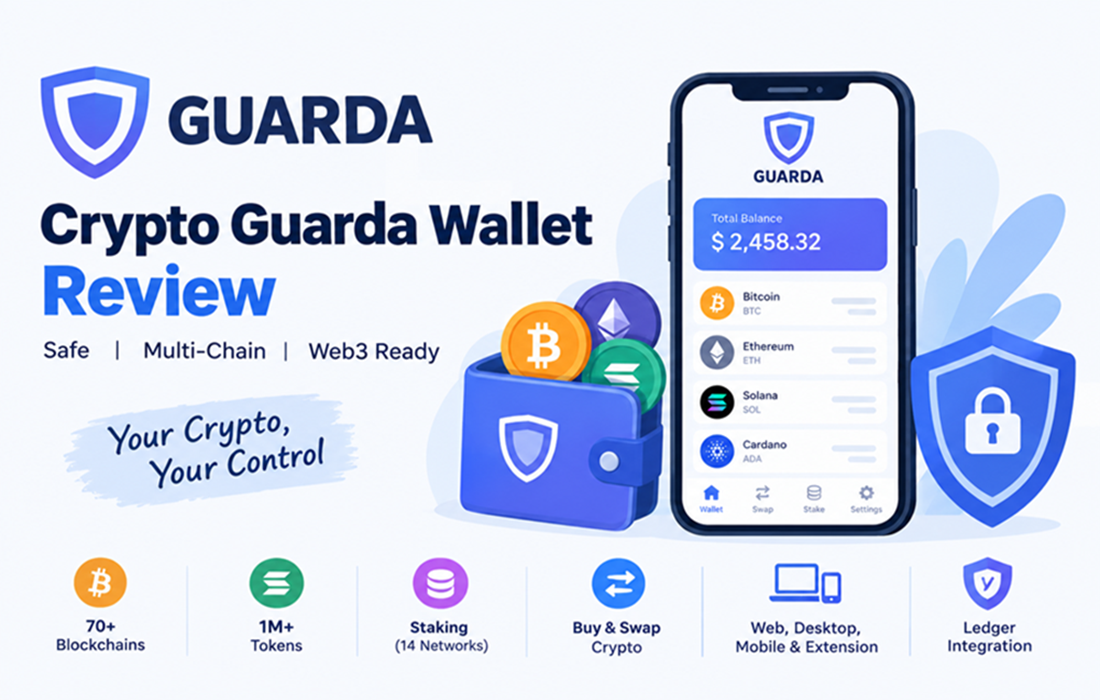
Guarda Wallet is a non-custodial cryptocurrency wallet designed for users who want to store, send, receive, swap, buy, and stake digital assets while keeping control of their private keys. Guarda currently advertises support for 70+ blockchain networks and more than 1 million tokens, with access through web, desktop, mobile, and browser-extension platforms.
Guarda has been operating since 2017, when its first Ethereum wallet was launched. Since then, it has expanded into a broader multi-chain wallet ecosystem with staking, crypto purchases, swaps, multisignature functionality, hardware-wallet integration, and other Web3-related services.
Guarda Wallet at a Glance
| Feature | Guarda Wallet |
|---|---|
| Wallet type | Non-custodial / self-custody |
| Launch | 2017 |
| Supported networks | 70+ |
| Supported assets | 1M+ tokens advertised |
| Mobile | iOS & Android |
| Desktop | Windows, macOS, Linux |
| Web Wallet | Yes |
| Browser Extension | Chrome |
| Staking | 14 networks |
| Hardware wallet | Ledger integration |
| Buying crypto | Yes, through integrated providers |
| Crypto swaps | Yes |
| Multisig | Supported for compatible assets/workflows |
| Web3/DApps | WalletConnect and browser extension |
| Customer support | 24/7 support advertised |
| Editorial rating | 8.7/10 |
Asset counts, supported networks, payment methods, and third-party services can change over time and can vary by jurisdiction.
What Is Guarda Wallet?
Guarda Wallet is a non-custodial crypto wallet, meaning Guarda says users not Guarda-control their private keys and crypto assets. Private information and key material are designed to remain under the user’s control rather than being held as exchange-style custodial balances.
The wallet supports a wide range of major cryptocurrencies and blockchain ecosystems, including assets such as Bitcoin, Ethereum, Solana, BNB, XRP, Cardano, Polkadot, Litecoin, Monero, Cosmos, Tron and Polygon, alongside a much larger collection of tokens.
The main idea behind Guarda is convenience without giving up self-custody. Instead of maintaining separate applications for every network, users can manage many blockchain assets through one wallet interface.
Guarda Wallet Launch and History
Guarda was launched in 2017, beginning with an Ethereum wallet. The company says its product ecosystem subsequently expanded from single-currency wallets into web, desktop and mobile products and later added multi-currency support, staking, token-generation features, multisig capabilities, and hardware-wallet integrations.
Guarda Wallet timeline
| Year | Development |
|---|---|
| 2017 | First Guarda Ethereum wallet launched |
| Following years | Web and multi-currency wallet expansion |
| Later development | iOS and Android applications |
| Expansion | Staking and Bitcoin multisig functionality |
| Current ecosystem | 70+ blockchains, 1M+ tokens advertised, Web3 and hardware integrations |
For a crypto wallet, longevity matters because users are trusting software with access to assets that cannot normally be reversed after an erroneous or malicious transaction.
Why Use Guarda Wallet?
Guarda is primarily attractive to people who want self-custody plus broad multi-chain support.
1. Non-custodial control
Guarda says it does not store users’ private keys, passwords, or wallet data on its servers. This means the user remains responsible for securing recovery information.
2. Broad cryptocurrency support
The wallet advertises 70+ blockchain networks and 1M+ tokens, giving users the ability to manage a very large variety of assets from one ecosystem.
3. Multiple platforms
Guarda is available through web, desktop and mobile applications, with a Chrome extension for browser-based Web3 interactions.
4. Staking
Guarda currently advertises staking across 14 networks. Supported assets include networks such as Cardano, Cosmos and TRON, although staking availability and reward conditions differ by asset.
5. Integrated crypto purchases and swaps
Users can buy crypto through integrated payment providers and swap supported assets without necessarily leaving the Guarda ecosystem. Payment methods can include cards, Apple Pay, Google Pay and bank transfers depending on the region and provider.
6. Ledger integration
Guarda supports Ledger hardware wallets, allowing Guarda to act as the interface while the Ledger device handles transaction signing and protects the relevant private keys.
How Does Guarda Wallet Work?
Using Guarda is relatively straightforward.
Step 1: Create a wallet
A user creates a wallet through the Guarda website, application, or supported platform.
Step 2: Protect the wallet
Guarda uses several forms of wallet credentials, including a password, encrypted backup, recovery phrase, and individual private keys depending on the wallet and recovery method.
Step 3: Add cryptocurrency
Users can receive crypto from an exchange or another wallet, purchase supported crypto through integrated providers, or swap one supported asset for another.
Step 4: Manage assets
Once funds arrive, users can monitor balances, send and receive assets, swap cryptocurrencies, stake supported assets, and use supported Web3 functionality.
Step 5: Backup and recovery
This is one of the most important parts of using Guarda.
Guarda explains that an encrypted backup can restore the complete Guarda wallet, while a recovery phrase can restore wallets created from that phrase, and a private key can restore a specific wallet.
Never share your recovery phrase, private keys, backup file, or wallet password with anyone. Guarda states that its support team will not ask for these credentials.
Is Guarda Wallet Safe?
The answer depends on what “safe” means.
Guarda has a non-custodial architecture, which reduces the risk of the wallet provider directly holding customer keys. The company says private keys are generated and stored locally, and users control their recovery information.
It also provides features such as:
| Security Feature | What It Does |
|---|---|
| Non-custodial design | User controls private keys |
| Encrypted backup | Protects wallet recovery data |
| Password protection | Secures wallet access and backup decryption |
| Biometrics | Adds device-level protection on supported mobile devices |
| Multisig | Can require multiple signatures for compatible wallets |
| Ledger support | Keeps signing keys on supported hardware |
| Address-book/security controls | Helps reduce mistakes in transactions |
The important security warning
A non-custodial wallet transfers much of the security responsibility to the user.
If malware steals a private key, a user approves a malicious transaction, or a recovery phrase is exposed, the wallet provider generally cannot reverse the blockchain transaction.
Guarda itself also experienced a 2020 domain-compromise incident, in which attackers redirected its domain to a phishing page. The incident demonstrates why users should use official URLs, verify wallet software, and never enter backup or recovery information into suspicious pages. Current third-party analysis also highlights phishing, malware, malicious DApps, and hot-wallet exposure as continuing risks for software wallets.
Guarda Wallet Fees
Guarda does not have one universal fee for every transaction.
For normal blockchain transfers, Guarda says it does not charge an additional wallet fee; users pay the relevant network fee required by the blockchain.
However, buying and swapping cryptocurrency can involve other costs.
Potential Guarda-related transaction costs
| Activity | Possible Cost |
|---|---|
| Sending crypto | Blockchain/network fee |
| Receiving crypto | Usually no Guarda receiving fee, but network rules apply |
| Swapping crypto | Provider charges, spread and network costs may apply |
| Buying with card | Payment-provider charges and crypto pricing/spread may apply |
| Bank/other payment methods | Varies by provider and region |
| Staking | Network/validator-related conditions can apply |
Guarda recommends looking at the actual amount of crypto received, rather than relying only on a headline fee percentage.
This is important because an apparently low-fee swap can still have a higher effective cost if the exchange rate or spread is unfavorable.
Guarda Wallet Staking
Staking is one of Guarda’s notable features.
The current Guarda website advertises staking across 14 networks, with examples including Cardano, Cosmos and TRON.
Staking can be convenient for users who already want to hold a supported proof-of-stake asset and prefer to manage it through the same wallet.
However, staking rewards are not guaranteed returns. Rates, validator fees, lockup periods, network rules, and unstaking periods can vary significantly from one blockchain to another.
The advertised reward rate should therefore be treated as network-specific information rather than a guaranteed Guarda yield.
Guarda Wallet and Web3
Guarda has expanded beyond basic send-and-receive wallet functionality.
Its ecosystem includes browser-based Web3 functionality, WalletConnect support, integrated swaps and other services. The current website also highlights prediction markets and perpetuals within the product ecosystem.
For active Web3 users, this can reduce the need to switch between multiple wallet applications.
But Web3 functionality also creates additional security considerations.
Users should carefully inspect:
- What application they are connecting to
- Which wallet address is being connected
- What transaction they are signing
- Whether a token approval is unlimited
- Whether the website and contract are legitimate
A wallet cannot make a malicious smart contract safe simply because the transaction is being signed through a reputable wallet interface.
Guarda Wallet With Ledger
One of Guarda’s more useful features for security-conscious users is Ledger integration.
When connected correctly, Guarda can provide the user interface while the Ledger device stores and signs with its own private keys. Guarda’s documentation explains that the Ledger-generated private keys do not leave the device during signing.
This creates a useful distinction:
Guarda alone: software-wallet model with hot-wallet exposure.
Guarda + Ledger: Guarda interface combined with hardware-based signing.
For users holding significant cryptocurrency balances, this distinction can be important.
Guarda Wallet Pros
Pros
Non-custodial: Users control their private keys and recovery information.
Very broad asset support: Guarda advertises 70+ blockchains and more than 1 million tokens.
Multi-platform: Web, desktop, iOS, Android and Chrome extension support are available.
Staking: Supports staking across 14 networks.
Ledger integration: Users can combine Guarda’s interface with hardware-wallet security.
Integrated services: Buying, selling, swapping and other crypto functions are available within the ecosystem.
Long operating history: Guarda says its first wallet launched in 2017.
Support: The current website advertises 24/7 live support.
Guarda Wallet Cons
Cons
Self-custody means self-responsibility: Guarda cannot simply reset your wallet like a traditional online account if critical recovery information is lost.
Hot-wallet risk: Standard software wallets remain exposed to device, malware, browser and phishing risks.
Third-party costs: Fiat purchases and swaps can involve external providers and different pricing structures.
Feature differences: Supporting a cryptocurrency does not necessarily mean every feature-such as staking, swaps or Web3 access-is available for that asset on every platform.
Backup management requires attention: Guarda specifically recommends maintaining an up-to-date backup after creating, importing, or removing wallets.
Web3 adds risk: DApps and smart-contract approvals introduce additional security considerations.
Who Should Use Guarda Wallet?
Guarda can be particularly useful for crypto users who want to manage multiple blockchain networks from one self-custody wallet.
It may suit:
Multi-chain holders: Users managing Bitcoin, Ethereum, Solana, Cardano, Tron, XRP and other networks.
Staking users: People who want staking functionality inside the same wallet.
Web3 users: Users who want browser or WalletConnect-based Web3 access.
Hardware-wallet users: Ledger owners who want a different software interface.
Beginners: Users who prefer having multiple cryptocurrency functions in one application, provided they understand self-custody responsibilities.
Who May Prefer Another Wallet?
Guarda may not be the ideal fit for someone whose first priority is a dedicated hardware-only experience, highly specialized DeFi functionality, or the simplest possible recovery setup.
A software wallet also should not automatically be treated as a substitute for cold storage for every long-term holding.
For users with larger balances, combining Guarda with compatible hardware such as Ledger can create a different security model from using a software-only wallet.
Guarda Wallet Rating: 8.7/10
Our editorial rating is based on features, custody model, asset coverage, usability, staking, integrations, fees, and security considerations.
| Category | Rating |
|---|---|
| Security & self-custody | 8.7/10 |
| Supported assets | 9.6/10 |
| Features | 9.0/10 |
| Staking | 8.8/10 |
| Ease of use | 8.5/10 |
| Fees & value | 8.0/10 |
| Platform availability | 9.0/10 |
| Web3 integration | 8.7/10 |
| Customer support | 8.8/10 |
| Overall | 8.7/10 |
The score reflects Guarda’s combination of wide asset coverage, self-custody and multi-platform functionality, while accounting for the responsibilities and risks that come with software-wallet security.
Final Verdict: Is Guarda Wallet Worth Considering?
Guarda Wallet is a feature-rich, non-custodial crypto wallet with particularly broad multi-chain coverage. Its current ecosystem combines storage, transfers, staking, swaps, fiat purchases, Web3 functionality and Ledger integration.
Its biggest advantage is convenience: users can manage a large number of assets without moving between many different wallet interfaces.
Its biggest limitation is also inherent to self-custody: you are responsible for protecting the keys, backup, recovery phrase and password.
For everyday multi-chain management, Guarda offers a broad feature set. For larger long-term holdings, users may consider pairing Guarda with supported hardware such as Ledger rather than relying exclusively on a software wallet.
Our Guarda Wallet review rating: 8.7/10.
Crypto wallets do not eliminate market or asset risk. Users should verify supported networks, fees, provider terms and local requirements before making a transaction.
Frequently Asked Questions About Guarda Wallet
Is Guarda Wallet legit?
Guarda has operated since 2017 and currently provides web, mobile, desktop and browser-based wallet products. It describes its wallet as non-custodial, meaning users control their private keys.
Is Guarda Wallet safe?
Guarda uses a non-custodial model in which private keys remain under user control, with additional security options such as encrypted backups, password protection, biometrics and Ledger integration. However, the user’s device and recovery information remain critical security points.
Is Guarda Wallet free?
Creating and using the wallet itself does not necessarily mean every activity is free. Guarda says normal blockchain transfers do not incur an additional Guarda fee, but network fees and third-party costs can apply to swaps and fiat purchases.
How many cryptocurrencies does Guarda support?
Guarda currently advertises more than 1 million tokens across 70+ blockchain networks. Actual functionality varies by asset and network.
Can I buy Bitcoin with Guarda?
Yes. Guarda supports integrated crypto purchases through payment providers, with available payment methods depending on the user’s location and provider.
Does Guarda support staking?
Yes. Guarda currently advertises staking on 14 networks. The exact assets, rewards and staking conditions depend on the blockchain.
Does Guarda work with Ledger?
Yes. Guarda supports Ledger integration so that users can manage supported assets through Guarda while transaction signing is performed by the Ledger hardware device.
Does Guarda have a seed phrase?
Guarda’s current documentation describes several recovery methods, including a 12-word recovery phrase, encrypted wallet backup, and individual private keys. Different wallets or imported assets can have different recovery arrangements.
What happens if I lose my Guarda password?
Guarda says it cannot recover or reset a lost password because the password is not stored on its servers. If you still have the appropriate recovery phrase or private keys, you may be able to restore access through another wallet or a new Guarda installation.
Does Guarda require KYC?
Creating a self-custody wallet is different from buying cryptocurrency with fiat. Guarda says payment/on-ramp providers may require identity verification depending on the country, regulations and provider.
Can I use Guarda for Web3?
Yes. Guarda provides browser-extension and WalletConnect functionality for supported Web3 applications. Users should still verify DApps and carefully review transaction approvals before signing.
What is the biggest risk of using Guarda?
The largest practical risk is not simply the wallet software itself but loss or exposure of recovery information, device compromise, phishing, malicious DApps, or signing an unintended transaction. Guarda’s non-custodial model means the user carries much of the responsibility for protecting access.